We’re Here to Help!

Understanding the Top Cybersecurity Risks in Modern Digital Banking Platforms
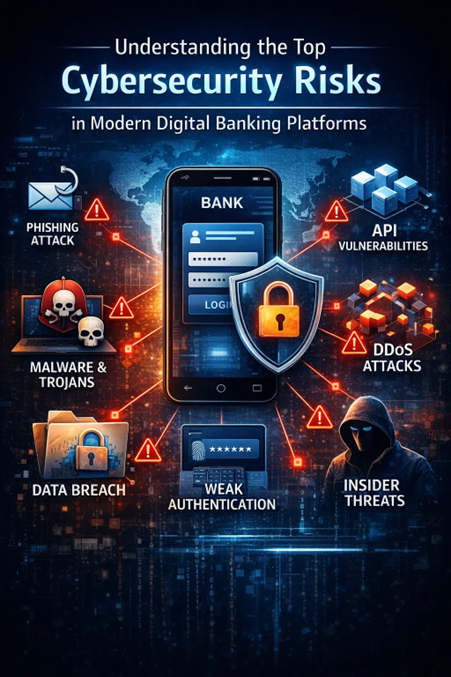
Digital banking has rapidly transformed the way financial services are delivered. Today, customers heavily rely on mobile banking applications, online portals, and digital payment systems to manage their everyday financial transactions. While this digital evolution has improved convenience and accessibility, it has also significantly expanded the cyber threat landscape.
Banks and financial institutions handle highly sensitive information, including personal data, transaction records, and payment credentials. Because of the immense value of this data, digital banking platforms have become prime targets for cybercriminals. Even a single security vulnerability can result in:
• Financial losses
• Reputational damage
• Regulatory penalties
• Loss of customer trust
To strengthen their cybersecurity posture, financial institutions must understand the most common threats that impact digital banking systems.
Top 10 Cybersecurity Risks in Digital Banking Platforms
1. Phishing and Social Engineering Attacks
Phishing continues to be one of the most effective attack methods targeting both banking customers and employees. Cybercriminals often create fraudulent emails, messages, or websites that closely resemble legitimate banking platforms.
These attacks aim to trick users into revealing sensitive information such as login credentials or financial data.
Key Risks Include:
• Credential theft
• Unauthorized account access
• Fraudulent transactions
• Data harvesting
Mitigation Measures:
• Strong authentication mechanisms
• Advanced phishing detection systems
• Continuous customer awareness programs
2. Weak Authentication Mechanisms
Authentication acts as the first line of defense in digital banking systems. However, many platforms still rely on outdated authentication methods such as simple passwords or poorly implemented multi-factor authentication.
Attackers exploit these weaknesses through techniques like:
• Credential stuffing
• Brute force attacks
• Password reuse
Recommended Security Controls:
• Adaptive multi-factor authentication (MFA)
• Biometric authentication
• Risk-based authentication frameworks
3. API Security Vulnerabilities
APIs (Application Programming Interfaces) play a critical role in modern banking ecosystems by enabling communication between:
• Banking applications
• Fintech platforms
• Mobile banking services
• Third-party integrations
However, poorly secured APIs can expose sensitive data and core banking logic.
Common API Security Risks:
• Broken authentication
• Excessive data exposure
• Improper access control
• Insecure endpoints
Without proper API security testing, attackers may manipulate transactions or access confidential information.
4. Mobile Banking Application Vulnerabilities
Mobile banking applications have become the primary access channel for millions of customers. Unfortunately, insecure development practices can introduce vulnerabilities within these apps.
Common Mobile Banking Risks:
• Insecure local data storage
• Weak encryption mechanisms
• Improper certificate validation
• Exposed API endpoints
If these vulnerabilities are exploited, attackers may:
• Reverse engineer applications
• Extract sensitive data
• Intercept communication between users and banking servers
5. Distributed Denial of Service (DDoS) Attacks
Distributed Denial of Service (DDoS) attacks aim to overwhelm banking infrastructure with massive traffic volumes, preventing legitimate users from accessing digital services.
Impact of DDoS Attacks:
• Disruption of banking services
• Financial operational downtime
• Damage to brand reputation
• Loss of customer trust
Financial institutions must implement:
• Advanced traffic monitoring
• DDoS mitigation technologies
• Scalable and resilient infrastructure
6. Insider Threats
Not all cybersecurity risks originate externally. Insider threats—whether malicious or accidental—can expose sensitive data or compromise banking systems.
These threats may arise from:
• Employees misusing privileged access
• Compromised employee credentials
• Unintentional internal errors
Effective Mitigation Strategies:
• Strong access control policies
• Continuous activity monitoring
• Privileged Access Management (PAM) solutions
7. Third-Party and Supply Chain Risks
Digital banking platforms often rely on third-party vendors for services such as:
• Payment processing
• Cloud infrastructure
• Customer support systems
• Data analytics platforms
If these vendors maintain weak security practices, they can become entry points for attackers.
Risk Reduction Measures:
• Vendor security assessments
• Third-party risk management programs
• Compliance audits and monitoring
8. Malware and Banking Trojans
Cybercriminals frequently deploy specialized malware designed to target financial systems. Banking trojans are capable of:
• Stealing login credentials
• Manipulating transactions
• Monitoring financial activities
Some advanced malware can also perform session hijacking, allowing attackers to take control of active banking sessions.
Security Controls Include:
• Advanced endpoint protection
• Behavioral threat detection systems
• Continuous monitoring and threat intelligence
9. Data Breaches and Exposure of Sensitive Information
Digital banking systems store large volumes of sensitive financial data, including:
• Personally Identifiable Information (PII)
• Payment card details
• Transaction histories
Improper configurations in databases, cloud storage, or application components can expose this data to attackers.
Potential Consequences:
• Regulatory fines
• Legal liabilities
• Severe reputational damage
Preventive Measures:
• Strong encryption practices
• Secure data storage policies
• Continuous security testing
10. Lack of Regular Security Testing and Vulnerability Management
One of the most overlooked risks in digital banking environments is the absence of regular security testing.
Many organizations rapidly release new features without conducting comprehensive security assessments, leaving vulnerabilities undetected for long periods.
Regular Vulnerability Assessment and Penetration Testing (VAPT) helps organizations identify security weaknesses before attackers can exploit them.
Strengthening Digital Banking Security with VAPT
To effectively defend against evolving cyber threats, financial institutions must adopt a proactive cybersecurity strategy.
Security testing should not be treated as a one-time activity but rather as a continuous process integrated into the organization’s security framework.
Regular VAPT engagements help organizations:
• Identify vulnerabilities in applications, APIs, and infrastructure
• Simulate real-world cyberattack scenarios
• Ensure compliance with financial security regulations
• Strengthen the overall security posture of digital banking platforms
Final Thoughts
As digital banking continues to evolve, cybersecurity threats will inevitably become more sophisticated and widespread. Financial institutions must remain vigilant and continuously assess the security of their digital platforms.
By understanding the most significant cybersecurity risks and implementing proactive measures such as vulnerability assessments and penetration testing, organizations can significantly reduce their exposure to cyber threats.
At Offensium Vault Private Limited (ISO 27001:2022 & ISO 9001:2015), we help financial institutions identify vulnerabilities and strengthen their digital infrastructure through comprehensive Vulnerability Assessment and Penetration Testing (VAPT) services.
In today’s digital banking ecosystem, proactive cybersecurity is no longer optional—it is essential for protecting financial systems, maintaining compliance, and preserving customer trust.